


“Any advice on how to manage my AI spend?”
I can’t count how many times I’ve heard that question this year.
On one hand, it’s a very fair question. It’s ridiculously easy to spend a LOT of money on AI tools and token costs. Companies that used to spend a few hundred dollars per employee per month on software are now suddenly spending thousands.
Yet, for all that spend, their top-line revenue isn't changing. As the saying goes: “Where’s the beef?”
On the flip side, the best organizations I know are asking a different question: “How can I spend more on AI?”
At the core, those two camps are getting different returns on investment. I see this over and over across all types of businesses, from software companies to construction companies.
The difference is the human processes.
For most companies, the traditional process for creating a new product or service might look something like this:
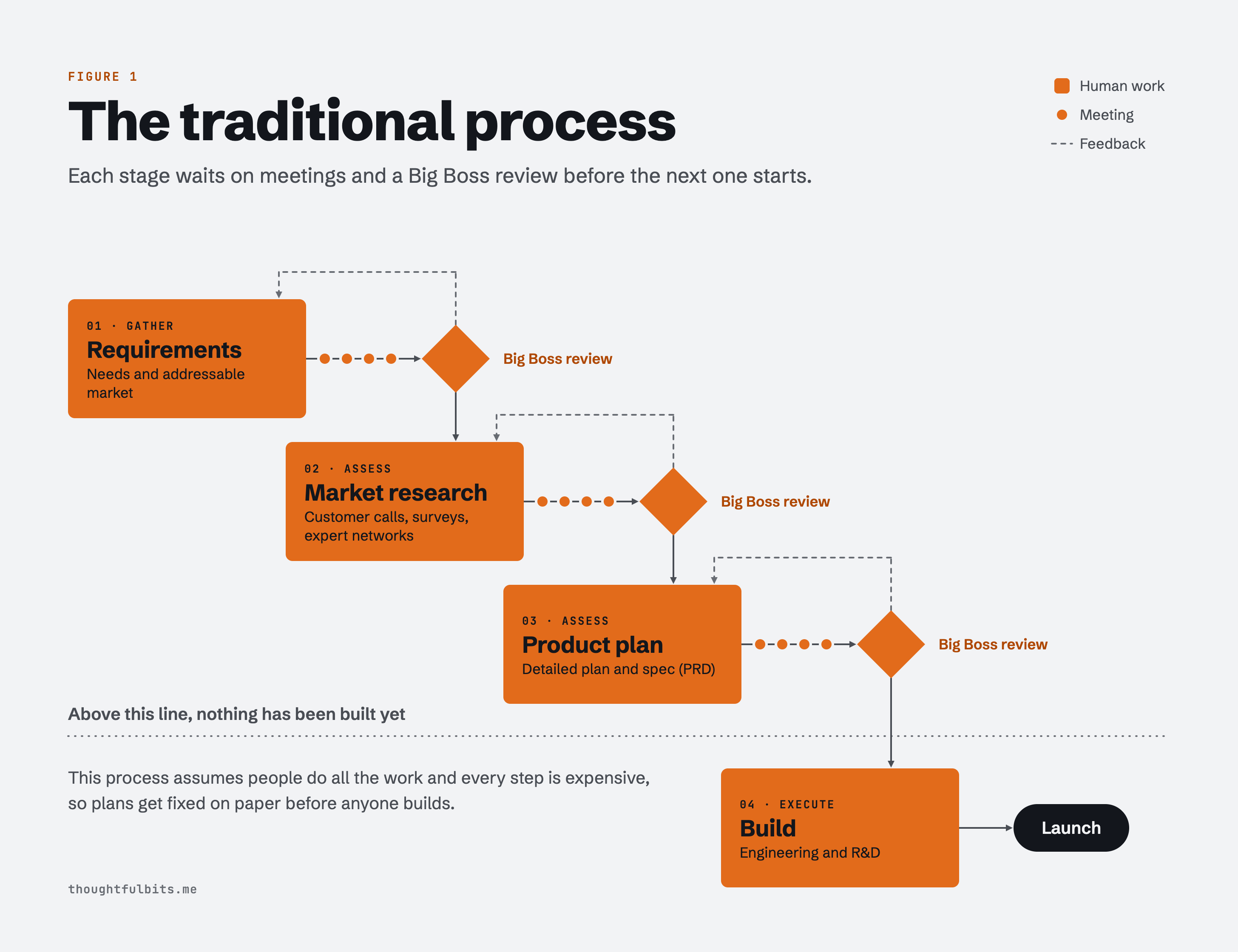
You start by gathering requirements and the addressable market. That takes many meetings, then eventually a meeting with the Big Boss. The Big Boss has some feedback, and you iterate again.
Passing that first gate, you then go do market research. Customer calls, surveys, expert network calls, you name it. Of course, more meetings, then a review with the Big Boss. Armed with that market information, you write a detailed product plan. More meetings, more reviews at every step.
Mind you, at this point in my description, nobody has built anything yet!
In a world where each step is expensive, that makes sense. Engineering is expensive. Market research can be expensive. It’s much cheaper to “fix” a product in a PowerPoint proposal than after you've sunk a billion dollars in R&D into it!
Unfortunately, AI just makes traditional processes even more expensive!
I see this over and over and over again. Companies run the exact same meetings, the exact same review-intensive processes as they did before. Only now, thanks to AI, the presentations are much longer. There is more debate—particularly over email! This is such a pervasive phenomenon that there is even slang for it: the meat proxy—a person who just copy/pastes or otherwise forwards the output of their Claude sessions.
Even when AI is used effectively at an individual level (such as an engineer writing code or a customer success manager analyzing literally every customer email and text), if that individual excellence is stuck in a traditional process, the organization will still move at the same speed as before and get the same results. They just have the added bonus of paying a lot of money to OpenAI and Anthropic.
Rethinking the Process
The solution is to rethink your processes assuming AI. What can be done automatically? What can be done in parallel? What really needs human input or decision-making?
This will obviously vary company by company and industry by industry, but it’s crucial to achieving the organizational financial benefits of AI technologies.
As a simple example, consider a software company.
The traditional way of building software very much follows the linear process outlined above. All bugs and feature requests are put into a big list. The team triages the list and chooses the most important items to work on. Then those features get written design documents (the “PRD”, product requirements document), and so on. Of course, every step requires many meetings and exec reviews at the major gates.
The best AI-native software companies are taking a much different approach:
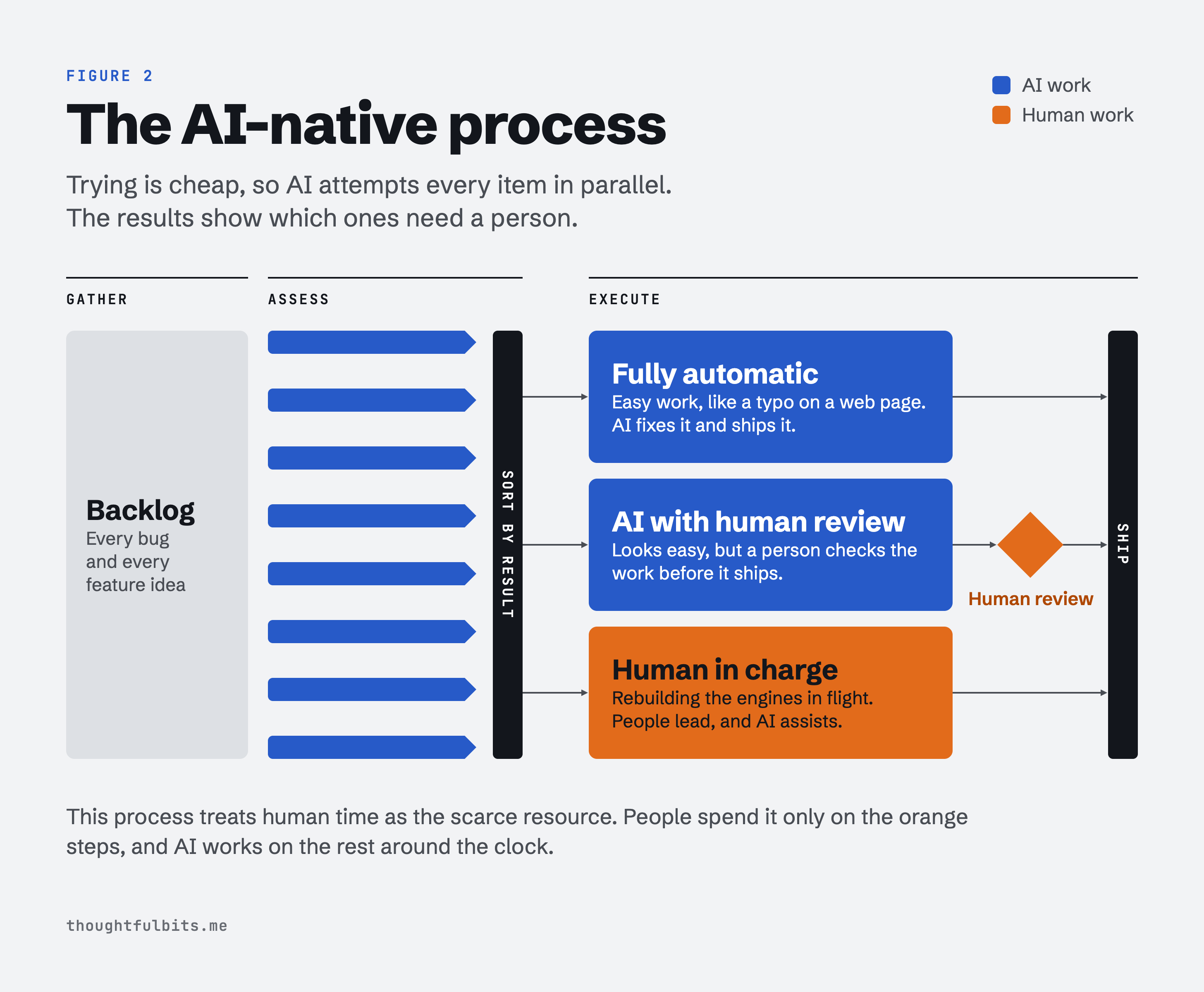
Why not have AI work on every bug, every feature idea in parallel and then automatically ship the best work?
This isn't as crazy as it sounds—and, needless to say, humans are involved in the process!
The key insight is to change the underlying assumptions behind the development process. The traditional process assumes human work is expensive, so we should optimize for that expense. The unwritten but fundamental assumption is that humans do all the work.
Now change that assumption: not all work has to be done by a human. Just some of it.
If you look at a software process with that perspective, suddenly it looks different:
Many bugs are pretty easy. At the most trivial level, consider a simple word misspelling on a web page. That can just be fixed. It doesn’t need much triage or a review with the Big Boss. Just fix it!
The interesting part is figuring out what else is easy. As a very relevant example, today I was working in a multi-million-line legacy codebase. There was some kind of configuration bug on one of the setups that spanned a Mac, Linux, and Windows machines. Ordinarily, the stuff of developer nightmares and really unpleasant to debug manually. Millions of lines of code running across scores of programs on multiple machines.
In this case, it turned out to be a nothing burger. I simply had Claude running in the background figuring it out while I was on a Zoom call. The fix was super trivial—a command that should have been running on Windows was running on the Mac. The ultimate fix, including documentation corrections, was only a few lines of code.
This is the “aha” behind rethinking the process. What is the scarce resource? Human time, most likely, but sometimes there will be other scarce resources (e.g., a particular piece of medical equipment). And if you don’t know what’s scarce, is there a way to quickly determine it?
That’s the idea in the AI-native software development process: “first just let the AI try to fix and implement everything.” AI for software development is constantly evolving, but importantly, it’s not perfect—it can’t just build anything.
Unfortunately, you don’t know what it can and cannot do until you try.
But because it’s so cheap to try, why not? Really, let the AI try to fix every bug and implement every feature. You’ll quickly be able to sort through which topics were super easy for the AI, which seemed easy but really ought to be double-checked by a human, and which fall into the “OMG, we’re rebuilding the airplane engines while we’re flying!” category.
Going further
One of the most amazing things we can do with AI now is create a dynamic process optimized for the current situation.
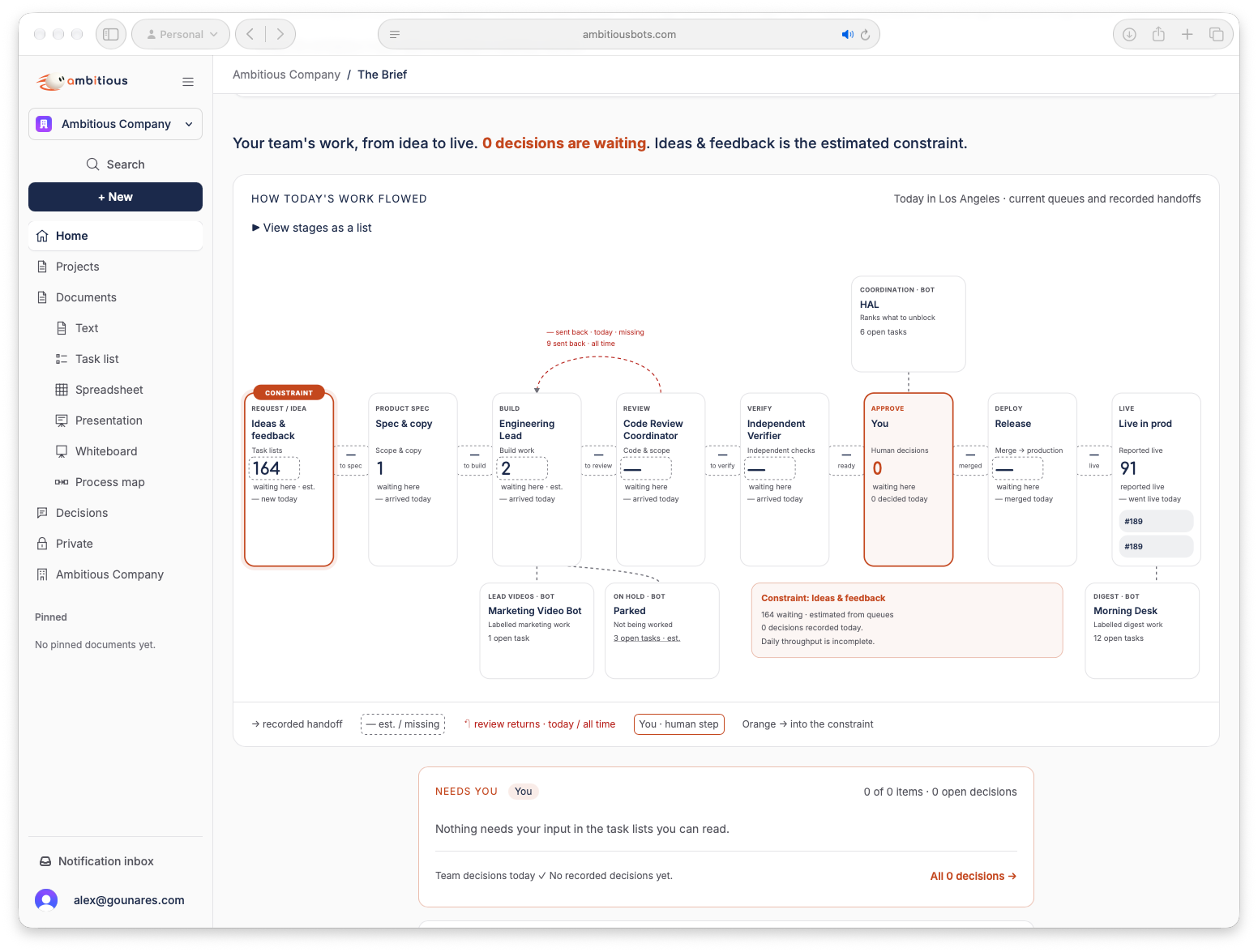
For my own software development, I now have a Grok Bot extension that helps me do as much coding work as possible in parallel. Not surprisingly, my time and availability are the biggest constraints. I might be in a board meeting or even just wanting to sleep, yet I want my AI to make progress anyway! Simply put, the more the AI works autonomously for me, the more I make! I want to spend more money on AI!
Thus, one of my tools every day tries to figure out what needs my input and decision-making. It front-loads those decisions to the times I have available to be in front of a computer and work (or in my car talking to Grok Bot—Tesla's native support for Grok is ridiculously addictive!).
Now my ‘hands-on keyboard’ work time focuses on making the decisions and taking the actions that need me; the rest of the time, AI bots work autonomously 24x7 to implement those decisions.
The same idea applies to many other businesses.
For example, in interior design, change requests can be time consuming. A customer may ask for a new peice of furniture, but not take into account the size of the piece, how it would block the door, how easy is it to clean, etc.
Normally that would be a lot of back and forth with a customer and the designer. To make it worse, these days many customers are doing designs in AI themselves!
But what if instead of letting customers use any random AI tool, the designer provided an AI tool preconfigured with all of the appropriate constraints (budgets, room dimensions, etc.). The back and forth now happens mostly with the AI, and then at the end with the human designer.
Customers are part of your processes!
This interior design example highlights an incredibly important point.
Optiming your processes for AI is not just an internal question—it can change how you interact with customers and partners too.
Software can automatically self-configure to meet the needs and workflows of your customers.
Retailers can make it easy to get all of the peices needed for a customer problem. Try going to Cabella’s to get outfitted for a fishing trip. They have everything you need, but good luck to any normal human figuring out exactly what to get! Why can’t AI help? Cabellas would almost certainly convince me to buy more stuff than I would on my own.
Bottom line, if you, your executives, or your board is asking about managing AI spend, I think you’re asking the wrong question. The real question is how do you fix your processes so that you’re optimizing for a world of both human and artificial intelligence.